When selecting an overseas VPS, many people overlook a variable that is rapidly changing the landscape: CMIN2. Users of China Mobile broadband, in particular, often face an awkward situation: they purchase a server labeled "CN2 GIA," only to find that while their friends on China Telecom enjoy blazing speeds, their own connection lags so badly during evening peak hours that they cannot even type an SSH command. The reason is simple: CN2 is a China Telecom network; traffic from China Mobile users exits via the China Mobile backbone and does not automatically switch to China Telecom's dedicated lines.
The emergence of CMIN2 is designed specifically to address the needs of this "overlooked majority."
What exactly is CMIN2?
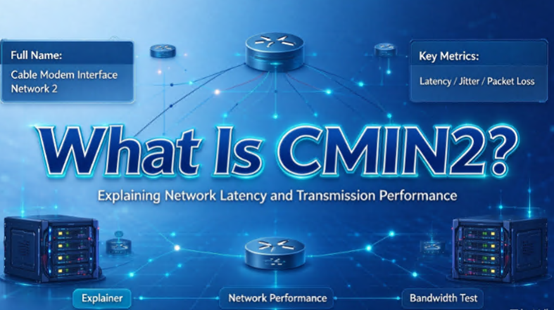
CMIN2 stands for China Mobile International Network 2. It is a premium international network brand launched by China Mobile International Limited after 2023, operating under Autonomous System number AS58807. Its positioning is clear: it rivals China Telecom’s CN2 GIA and China Unicom’s AS9929, serving as the highest-tier cross-border network line within the China Mobile ecosystem.
Compared to China Mobile’s standard international exit (CMI, AS58453), the fundamental difference with CMIN2 is its independence. Standard CMI is akin to an "ordinary national highway" where all China Mobile home broadband users crowd together to access the internet abroad; congestion during peak hours, QoS throttling, and unpredictable routing shifts are the norm. In contrast, CMIN2 boasts a dedicated international backbone network. Its overseas POP nodes connect directly to domestic landing points (Shanghai, Guangzhou, and Beijing) via dedicated channels, ensuring fixed routing paths and low link loads. Comparing the difference to that between a "superhighway" and an "ordinary national highway" is no exaggeration.
A direct comparison of data illustrates the point: for a connection from Los Angeles to Shanghai, CMIN2 latency is approximately 125–145ms, whereas standard China Mobile international lines range from 180–210ms—a difference of 40–60ms. For Hong Kong nodes, the CMIN2 return path can be as short as 2–3 hops, with latency consistently between 40–60ms and packet loss kept below 0.3%; meanwhile, packet loss on standard CMI lines can spike to over 5% during evening peak hours. Positioning the Three Premium Routes: Distinct Roles
Understanding CMIN2 clarifies the full landscape of premium overseas VPS routes as of 2026. Each of the three major carriers boasts a "flagship route," with distinct target audiences and technical approaches.
China Telecom’s CN2 GIA (AS4809) is the most established premium route; its core strength lies in cross-carrier routing capabilities. High-quality VPS providers typically configure "tri-network CN2 GIA return paths" to ensure that inbound traffic bypasses the congested 163 backbone network. Its downside is high cost, meaning it is usually reserved for high-end products.
China Unicom’s AS9929 benefits from a smaller user base, resulting in very low load rates and network performance that remains top-tier in 2026. At times, its stability even surpasses that of CN2 GIA, offering minimal latency jitter—making it ideal for real-time applications highly sensitive to packet loss.
CMIN2 is the "youngest" of the three but demonstrates the most significant advantages of being a latecomer. By 2026, it has optimized interconnectivity with China Telecom and China Unicom; while primarily serving China Mobile users, its latency performance for return traffic across all three networks is now very close to that of CN2 GIA.
The industry generally accepts the following ranking for outbound routes serving China Mobile users: CMIN2 > CN2 GIA ≈ AS9929 > CMI > AS4837.
Tri-Network Optimization: Each Carrier Takes Its "Own Expressway"
No single route, however powerful, can cover every user. A truly top-tier experience involves routing China Telecom users via Telecom’s dedicated lines, China Unicom users via Unicom’s dedicated lines, and China Mobile users via Mobile’s dedicated lines.
This is the core logic behind "tri-network optimization." For an overseas VPS configured with tri-network optimization, return traffic is intelligently routed based on the carrier: Telecom traffic travels via CN2 GIA (using dedicated 59.43 nodes), Unicom traffic via the AS9929 independent gateway, and Mobile traffic via the CMIN2 dedicated outbound channel. The three paths operate independently, with each carrier utilizing its own high-speed route.
The value of this architecture is most apparent during evening peak hours. With standard single-line VPS setups, users on carriers other than the primary one often experience significant latency jitter and packet loss spikes during these times. In contrast, a VPS optimized for all three major carriers maintains a consistent user experience across the board, avoiding the fragmented scenario where one carrier experiences lag while others remain smooth.
Verifying the effectiveness of this three-carrier optimization is straightforward. By running an `mtr` trace from the server to your local public IP and examining the return route, you can check for specific indicators: China Telecom lines should consistently show CN2 GIA nodes (starting with 59.43); China Unicom should show AS9929 gateways; and China Mobile should show CMIN2 nodes (starting with 223.120.*) with the core node identified as AS58807. True optimization is achieved only when the paths for all three carriers align with their respective premium nodes.
Jtti’s Implementation of Three-Carrier Optimization: Test Data and Configuration
Having understood the underlying principles, let’s look at Jtti’s actual configuration for this architecture.
Jtti’s Hong Kong node employs a direct-connection scheme combining CN2 GIA, AS4837, and CMI. For the Tokyo, Japan node, the China Mobile line has been upgraded from standard CMI to bidirectional CMIN2; combined with China Telecom’s CN2 GIA and China Unicom’s AS9929, this ensures that each carrier utilizes its optimal return path. Real-world test data shows that the average latency for Jtti’s Hong Kong node across all three carriers nationwide falls within the 40–63ms range (approximately 46ms for China Mobile, 67ms for China Unicom, and 76ms for China Telecom). For the Japan node, latency can be as low as 50ms in coastal regions, while remaining stable at 70–90ms for inland areas.
The Japan "Lightweight Cloud" plan comes with 200 Mbps of dedicated optimized bandwidth. Actual bandwidth utilization tests show figures approaching 90%, indicating virtually no inflated specifications. For scenarios requiring high-bandwidth data relay—such as AI tool traffic forwarding, cross-border e-commerce backend management, or video streaming—this level of bandwidth is rare among products at a similar price point. Dedicated bandwidth comes standard across the entire product line, eliminating the risk of speed drops during evening peak hours caused by "bandwidth contention" with neighbors.
A lifetime recurring discount policy ensures that the renewal price matches the initial purchase price; amidst rising hardware costs projected for 2026, long-term operating costs remain fully predictable.
The significance of CMIN2 lies not in "replacing" CN2 GIA, but in finally providing China Mobile users with a high-end option of their own. The value of "tri-network optimization" lies in integrating three premium routes, enabling users across different carriers to enjoy a top-tier experience within their respective network ecosystems.