Disturbingly, the Bologna data center in Italy, part of the European Centre for Medium-Range Weather Forecasts (ECMWF), one of the world's leading weather forecasting agencies, also experienced a brief data outage due to a cooling system malfunction caused by a heatwave. The system used to forecast the weather was defeated by the weather itself. This isn't science fiction; it's a reality unfolding in 2026.
Why is 2026 so special?
The exponential growth in demand for AI computing power is colliding head-on with the extreme weather brought about by El Niño.
The World Meteorological Organization (WMO) predicts that between 2026 and 2030, the global annual average near-surface temperature will be 1.3 to 1.9 degrees Celsius higher than the pre-industrial average. A strong El Niño event is expected at the end of 2026, significantly increasing the probability of breaking global temperature records in 2027. A report by the U.S. Federal Energy Regulatory Commission (FERC) also explicitly states that NOAA predicts a 61% probability of a "strong El Niño" later this year, increasing the risk of power outages.
Meanwhile, data from the International Energy Agency (IEA) shows that the proportion of electricity consumed by AI data centers in global power generation will surge from 1.8% in 2023-2025 to 3.7%-4% in 2026. Goldman Sachs predicts that data center load in the United States alone will nearly double, from 31 gigawatts to 66 gigawatts in just two years.
Summer is already a peak season for electricity demand, with air conditioning loads causing regional peak demand to surge by 20% to 30%. When seasonal cooling peaks collide with the 24/7 computing power demand, a "peak surge" phenomenon has occurred for the first time in human history—pushing the power grid to the brink of collapse.
The U.S. Department of Energy declared an energy emergency this year, instructing grid operators to require data centers to activate backup power when the power system needs relief. PJM, the largest grid operator in the U.S., has even proposed prioritizing the suspension of power to some data centers during extreme power shortages to avoid wider blackouts.
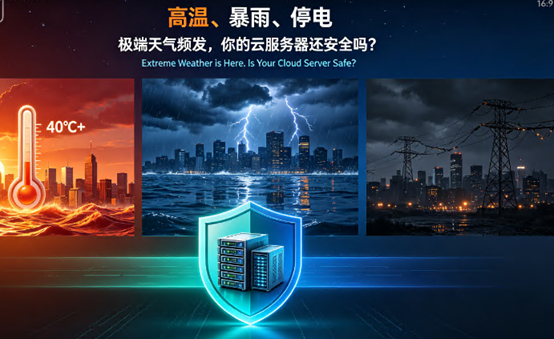
And this is just the threat of high temperatures. Heavy rains, floods, and typhoons—every extreme weather event tests the survivability of data centers.
79% of Global Data Centers on the Brink of Collapse
A shocking study by climate risk analysis firm First Street Research reveals that a staggering 79% of the computing capacity of global data centers is threatened by climate disasters such as floods, extreme winds, and wildfires. These disasters can lead to operational disruptions, increased downtime, and significantly higher insurance and maintenance costs.
Uptime Institute's 2026 outage analysis shows that cooling failures account for 14% of all major outages, making it the second leading cause after power outages. More than half of data center operators report losses exceeding $100,000 per outage, with some incidents exceeding $1 million.
The shutdown of Cambridge University's Dawn supercomputer stemmed from its cooling system's design standards being outdated compared to a time before such drastic climate change. The facility, originally designed to operate efficiently at 35°C, now faces external temperatures frequently exceeding 43°C, forcing the cooling system to operate at its limits. USystems stated in a subsequent announcement, "Our equipment operated exactly according to design specifications throughout the incident"—implying that the problem wasn't equipment failure, but rather that the climate was changing too rapidly and standards hadn't kept pace.
The Google Cloud Netherlands data center outage revealed another critical weakness: over-reliance on the upstream power grid. A single upstream electrical failure can paralyze an entire availability zone for nearly 15 hours. Furthermore, a transmission line failure at the world's largest data center cluster in Virginia, USA, in July of this year caused over 3 gigawatts of power demand to disappear from the grid within seconds, triggering voltage fluctuations from Washington D.C. to Chicago.
If your business happens to be deployed on these "high-risk" nodes, who will bear the losses from the outage?
Five Essential Security Indicators to Understand When Choosing a Cloud Server in the Era of Extreme Weather
In the past, choosing a cloud server focused on bandwidth, price, and configuration. In 2026, these are far from sufficient. The following five indicators are core capabilities you must consider in an era of frequent extreme weather:
Indicator 1: Tier Rating – The Data Center's "Shock Resistance"
The Uptime Institute's Tier rating is an internationally recognized standard for data center reliability. Tier III and above data centers support online maintenance; any planned maintenance will not affect equipment power supply and cooling. If your business cannot operate 24/7, choose at least Tier III. The Cambridge West data center, home to the Cambridge Dawn supercomputer, exposed a problem during this heatwave: insufficient redundancy in its cooling system design. Tier 1 tier status isn't just about "having redundancy," but also "having enough redundancy to handle extreme conditions."
Indicator Two: Power Redundancy – A Lifeline During Grid Instability
The root cause of the Google Cloud Netherlands incident was "an electrical failure in the upstream power grid." In 2026, the frequency of grid failures caused by extreme weather is rising sharply. A reliable data center must have:
- Dual mains power access (two different power sources)
- N+1 or 2N diesel generator redundancy (backup can immediately take over when the main generator fails)
- Sufficient UPS battery capacity (able to last until the generator starts during a power outage)
The U.S. Department of Energy has required data centers to activate backup power when the power grid is under pressure. If your data center lacks reliable backup power, you can only passively wait for recovery during a power grid emergency.
Indicator 3: Cooling Redundancy and Heat Dissipation Capacity – The “Lifeline” Under High Temperatures
The lessons of Cambridge Dawn are profound: the design margin of cooling systems must outpace the rate of global warming. Traditional air-cooled systems experience a sharp decline in efficiency under high temperature and humidity conditions. Currently, over 40% of AI data centers have completed liquid cooling retrofits. NVIDIA's latest AI servers can operate in coolant environments up to 45°C; for every 1°C increase in coolant temperature, cooling energy consumption decreases by 4%.
You need to ask your service provider: Does the cooling system have N+1 redundancy? Does it employ a multi-layered heat dissipation architecture? What is the upper limit of the design operating temperature for the cooling equipment?
Indicator 4: Geographical Location – Avoiding “Disaster-Prone Areas”
79% of global data center capacity faces the risk of climate disasters. Site selection directly determines the probability of a data center encountering disasters such as floods, wildfires, and hurricanes. When choosing a data center, consider: Is the data center located in a high-risk flood area? Is it located in a wildfire-prone area? What is the stability and redundancy level of the local power grid?
Microsoft's approach is worth considering: during the data center planning phase, they fully consider three key dimensions—site selection, redundant backup systems, and real-time monitoring—ensuring stable operation of data centers in diverse climatic environments.
Indicator Five: Disaster Recovery and Off-site Disaster Relief—The Last "Safety Net"
Even the best data centers can be vulnerable to extreme weather. Single-point deployment is a single point of failure. Google explicitly recommends in its incident reports that customers switch traffic to other sites—provided that multi-region deployment has been implemented beforehand.
You need to: Choose a service provider that supports multi-region deployment, deploy critical business operations in at least two data centers in different geographical regions, and establish an automatic failover mechanism.
In 2026, the "security" of cloud servers will be redefined.
Before 2026, when we talked about "cloud server security," we meant preventing attacks, intrusions, and data leaks. After 2026, the boundaries of "security" have been completely broadened by extreme weather—preventing high temperatures, power outages, and cooling failures is just as important as preventing hacker attacks.
Cambridge University's £300 million supercomputer can be crippled for a week at 37.7°C, and Google Cloud's availability zones can be down for 15 hours during a power grid failure. If your business happens to run on these nodes, the loss could be customer trust, business opportunities, or even the continuity of your entire business.
Jtti understands the severe challenges that extreme weather poses to enterprise infrastructure. We provide Tier III+ high-reliability data centers, equipped with dual-power mains + N+1 generator redundancy, multi-layered cooling architecture, and global multi-region deployment capabilities—ensuring your business remains rock-solid in 2026, a year prone to extreme weather.
Climate change will not stop, but you can choose to stand on a more solid foundation. If you are evaluating cloud server solutions, please contact Jtti; we will help you ensure that every "safety metric" is implemented effectively.