In 2026, if you're still leveraging traditional SEO logic for content promotion, you risk missing out on an entirely new traffic gateway – GEO. With the proliferation of AI‑powered tools, users have shifted from searching with keywords and clicking on links to directly asking AI questions and consuming AI‑generated answers. This transformation has given rise to a brand‑new optimization field: Generative Engine Optimization (GEO).
What is GEO?
GEO refers to the practice of adjusting and optimizing content so that it is more easily recognized, understood, cited, and recommended by generative search engines driven by large language models (LLMs). Its core objective is not to rank web pages higher in traditional search results, but to ensure that brands and their content are accurately interpreted, preferentially referenced, and positively recommended within the answers generated by AI systems such as DeepSeek, Doubao (Beanbag), Kimi, and Tongyi Qianwen.
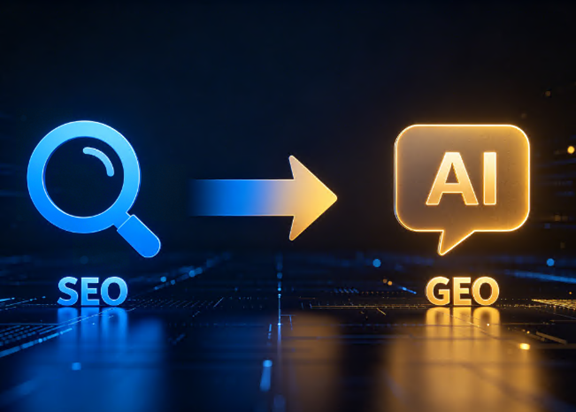
If SEO stands for “Search Engine Optimization,” then GEO is more akin to “AI Cognitive Optimization.” SEO centers on catering to crawlers – competing for rankings on search engine results pages through keyword density, backlink authority, and similar metrics. GEO, on the other hand, revolves around catering to reasoning – requiring that brand content be precisely cited when AI models formulate their responses. The distinctions between the two can be broken down across several dimensions:
- Objective: SEO aims to rank web pages higher in search results to attract user clicks; GEO aims to have content directly cited by AI and woven into the generated answer text.
- Target: SEO targets search engine crawlers and ranking algorithms; GEO targets the semantic understanding and fact‑extraction mechanisms of LLMs.
- Traffic Paradigm: SEO delivers click‑through traffic from users visiting a website via search links; GEO delivers brand mentions as information sources within AI conversations, without necessarily driving a click.
- Optimization Focus: SEO emphasizes page titles, keyword placement, and internal/external link building; GEO emphasizes clear question‑and‑answer structures, concrete data citations, authoritative source endorsements, and consistency of information across the web
According to a 2024 paper published by researchers at Princeton University, content optimized for GEO can achieve up to a 40% increase in visibility within AI‑generated answers. In 2026, the GEO market in China has reached approximately RMB 3 billion, reflecting a year‑on‑year growth of about 1,100%, with industry penetration rising from 38% in 2025 to 71% in 2026.
What Are the Main Factors Influencing GEO?
The workflow of generative search engines can be broadly divided into three phases: information crawling, semantic understanding, and answer generation. GEO optimization efforts need to target each of these phases accordingly. The primary influencing factors include:
Content Structuring
AI models tend to favor well‑structured, logically coherent text when crawling and parsing content. Using standard industry terminology, avoiding vague descriptions, and providing clear question‑answer frameworks all help AI interpret content more accurately. For example, “an online document tool that supports simultaneous editing by up to 20 users” is more effective than “a powerful collaboration software” – concrete descriptions are more readily recognized and cited by AI than ambiguous phrasing.
Factual Density and Data Support
When generating answers, AI extracts information from multiple sources. Content that contains specific data, verifiable facts, and explicit references is more likely to be selected as the basis for AI answers. Empty marketing rhetoric holds little weight in the GEO era because AI requires facts, not fluff.
Authoritative Sources and Trust Signals
At its core, LLM‑based GEO is a game of trust. When selecting answers, large models naturally gravitate toward more objective, credible content and assign it higher weight. Endorsements from authoritative sources, industry certifications, and third‑party evaluations all influence the priority AI gives to referencing particular content.
Cross‑Platform Information Consistency
If the same brand presents inconsistent information across different platforms – such as conflicting product specifications, company descriptions, or contact details – AI will encounter confusion during crawling and comparison, thereby reducing its trust in that brand’s information. Maintaining consistent and accurate information across the web is a foundational requirement for GEO optimization.
Technical Accessibility
AI model training and retrieval‑augmented generation (RAG) mechanisms rely on crawling publicly available web content. If a website has technical blocks, crawling obstacles, or slow loading times, its content may never enter the AI corpus. Techniques such as configuring an `llms.txt` file, maintaining a clear site structure, and providing structured data markup can significantly improve technical accessibility.
HTTPS Security Protocol
This is a frequently overlooked yet critically important factor in GEO. For businesses, deploying HTTPS is no longer optional – it has become a fundamental prerequisite for participating in the GEO competitive landscape.
This translation maintains the professional tone and technical accuracy required for official documentation, marketing materials, or educational content. All key terms, figures, and references are faithfully rendered in clear, standard English.