Cloud storage security is undergoing a fundamental shift. Attackers have moved beyond targeting end-user devices and are now going directly after the storage infrastructure itself — because that's where the most valuable data resides: customer information, intellectual property, financial records, AI training datasets, and backups.
Traditional ransomware encrypts files on endpoint devices to extort payment. But in 2026, cloud ransomware has completely changed the playbook.
Attackers no longer need to deploy malware. Instead, they steal cloud credentials, abuse Identity and Access Management (IAM) permissions, and delete snapshots and recovery vaults directly from cloud storage accounts. They disable resource locks and immutable policies, encrypt the remaining data with their own keys, and then delete those keys. Backups are the primary target — because intact backups eliminate all their bargaining power.
The impact of this attack vector is expanding rapidly. In 2025, cloud environment intrusions grew by 37% overall, while state-sponsored hacker group attacks targeting cloud environments surged by 266%. Ransomware was involved in 44% of all data breaches, and publicly reported ransomware attacks jumped from 4,900 in 2024 to 7,200 in 2025 — a 47% increase.
Why Traditional Backup Strategies Fail in 2026
Many enterprises still believe that "having backups means being safe." But in the 2026 threat landscape, this assumption is being completely overturned:
Myth #1: Storing backups under the same cloud account is sufficient.
After breaching an environment, attackers can delete both production data and backup data simultaneously. If backups reside in the same cloud account as production data, those backups might as well not exist.
Myth #2: Immutable backups are absolutely secure.
Immutable backups do prevent data from being altered or deleted. However, an immutable snapshot of a compromised database remains infected. If you back up data that has already been contaminated by ransomware, restoring from that backup simply restores the contamination.
Myth #3: Built-in cloud provider security features are enough.
Most cloud providers' native security capabilities fall far short when facing targeted attacks. Attackers can exploit the cloud provider's own APIs and configuration vulnerabilities to carry out their attacks.
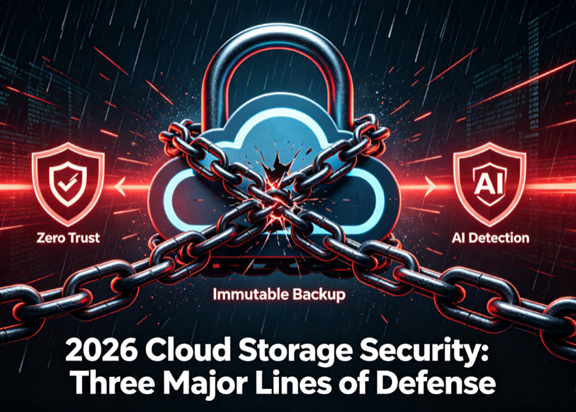
2026's Three Essential Security Lines of Defense for Enterprise Cloud Storage
To counter these escalating threats, enterprises must establish the following three lines of defense:
Defense Line 1: Zero Trust Architecture & Identity Management
The Zero Trust framework operates on a "never trust, always verify" approach, requiring continuous authentication and authorization for both users and devices. Enterprise cloud storage solutions must support Role-Based Access Control (RBAC), Multi-Factor Authentication (MFA), and Single Sign-On (SSO) integration. The 2026 best practice also mandates implementing Zero Trust policies specifically for storage access, eliminating shared credentials and unmanaged service accounts.
Defense Line 2: Immutable Backups & Isolated Storage
Immutable backups ensure that once data is written, it cannot be modified or deleted for a specified retention period. Combined with an air-gapped strategy — physically or logically isolating backup data from the production network — even if attackers breach the production environment, they cannot reach the backup data. Multi-region redundancy further ensures that backups remain available even if one data center is compromised.
Defense Line 3: AI-Driven Anomaly Detection & Intelligent Recovery
Artificial intelligence is playing an increasingly critical role in backup security. AI systems can monitor for anomalous behavior in real time — such as sudden mass encryption of files, unexpected backup job failures, or abnormal access patterns to backup repositories — and automatically pause operations, alert administrators, or even quarantine affected components when anomalies are detected.
More importantly, performing granular recovery from verified clean points-in-time — restoring only affected individual tables or records rather than rolling back the entire environment — is the key determinant of downtime duration.
The Bottom Line
The cloud storage security landscape in 2026 is clear: attackers are directly targeting your storage and backup systems. The foundational security protections offered by cloud providers are no longer sufficient against the sophisticated, targeted attacks of professional threat actors. Enterprises must build a multi-layered defense framework that spans identity management, immutable backups, real-time monitoring, and intelligent recovery. In an era of increasingly aggressive ransomware attacks, choosing a cloud storage solution with enterprise-grade security capabilities is not optional — it is essential.