As one of Asia’s most critical network hubs, Japan—with its advantageous geographical location and highly developed infrastructure—serves as an ideal node for deploying high-bandwidth services. This article explores why high-bandwidth cloud servers in Japan act as a powerful accelerator for cross-border business, examining both their technical advantages and practical application scenarios.
Why Choose a Japanese Node? The Dual Benefits of Geography and Infrastructure
Situated in the heart of East Asia, Japan hosts several world-class data center clusters, notably in Tokyo and Osaka. Its physical proximity to China’s coastal regions, combined with high-quality submarine cable infrastructure, enables cross-border data transmission with exceptionally low latency.
Furthermore, Japan boasts an abundance of international egress bandwidth. As a core node in the global internet, Japanese data centers offer not only high-speed connectivity across the Asia-Pacific region but also inherent routing advantages for traffic destined for North America and Europe. For businesses targeting both Asian and global markets, Japan serves as an excellent "network transit hub." Additionally, most Japanese data centers meet or exceed Tier III+ standards, offering robust power and network redundancy that ensures the stable operation of high-bandwidth services.
Core Advantages of High-Bandwidth Cloud Servers in Japan
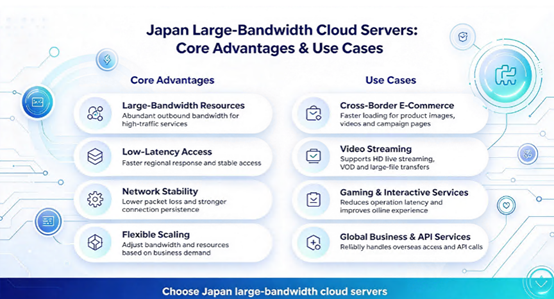
First, they overcome concurrency bottlenecks, allowing businesses to handle traffic surges with ease. Traditional, low-bandwidth servers often suffer from request timeouts during sudden traffic spikes—such as those seen during major e-commerce sales or flash-sale events—due to egress congestion. High-bandwidth solutions (e.g., 100 Mbps, 200 Mbps, or higher) provide ample throughput headroom. This not only supports a greater number of concurrent connections but also allows the system to absorb smaller-scale traffic attacks through sheer bandwidth capacity, buying critical time for threat mitigation and defense.
Second, they deliver superior data transmission efficiency. For websites featuring high-definition imagery, video streams, or large installation files, bandwidth is the primary factor determining initial page load times. High-bandwidth capacity transforms data delivery from a "trickle" into a "torrent," which is essential for enhancing user experience and reducing bounce rates.
Third, they support a more diverse range of business models. Standard bandwidth is generally only sufficient for lightweight website hosting, whereas high-bandwidth solutions unlock resource-intensive use cases—such as video-on-demand, live streaming, CDN edge nodes, large-scale game server hosting, and enterprise-grade off-site disaster recovery.
Typical Use Cases for High-Bandwidth Cloud Servers in Japan
Scenario 1: Streaming Media and Video Distribution. Video-based services are notorious "bandwidth hogs." For instance, a single 4K high-definition video stream requires a consistent bandwidth of approximately 25–50 Mbps. A Japan-based cloud server equipped with 200 Mbps of dedicated bandwidth can easily handle multiple simultaneous HD video streams. For film/television websites or short-video platforms targeting the East Asian market, a Japanese node ensures smooth playback without stuttering or buffering.
Scenario 2: Cross-Border E-commerce Sites. Modern e-commerce websites are often image-heavy and frequently incorporate embedded videos and dynamic interactive elements. If bandwidth is insufficient, slow page load times for overseas customers can severely negatively impact conversion rates. Deploying on a high-bandwidth node in Japan—complemented by optimized network routes—ensures a seamless experience for both the management team (based in China) and consumers across Asia.
Scenario 3: Game Acceleration and Online Gaming Services. Competitive gaming is extremely sensitive to latency and requires a very low packet loss rate for UDP traffic. High-bandwidth capacity ensures the rapid delivery of game updates and maintains the swift transmission of game commands, even during peak evening hours when network congestion typically occurs.
Scenario 4: Enterprise Data Backup and CDN Nodes. Multinational corporations often need to transfer massive volumes of data for off-site synchronization or the deployment of CDN distribution nodes. High-bandwidth cloud servers significantly shorten backup windows, ensuring real-time synchronization of critical business data.
How to Avoid Pitfalls When Purchasing "High-Bandwidth" Services?
Many products on the market are advertised as "high-bandwidth," but their quality varies significantly. The most important rule is to look specifically for "dedicated bandwidth." Many low-cost hosting plans rely on shared bandwidth. While they may be advertised as "200Mbps," hundreds of users often crowd onto a single egress point during evening peak hours—meaning you might be lucky to get even a fraction of that speed. True high-bandwidth service must be "dedicated," meaning the channel is reserved exclusively for you, allowing you to reach the full advertised speed even during peak periods. Furthermore, it is essential to check whether the return route (inbound path) is optimized—for instance, through direct peering with major carriers or by using premium routes like CN2. Without this, even with massive bandwidth, your data packets may take inefficient detours across the public internet, keeping latency high.
Jtti’s High-Bandwidth Solutions in Japan: The Perfect Blend of High Throughput and Low Latency
Once you understand your requirements and the potential pitfalls, choosing a robust, well-built server becomes critical. Jtti’s Tokyo-based node is specifically tailored for high-bandwidth scenarios.
Jtti’s Japanese "Lightweight" Cloud Servers offer 200Mbps of dedicated, optimized bandwidth, eliminating the congestion issues typical of shared connections. At the network level, the service utilizes optimized return routes for China’s three major carriers (China Telecom, China Unicom, and China Mobile), ensuring the best possible path for each. In real-world tests, latency from coastal China can be as low as ~50ms, while inland regions see a stable 70–90ms.
For example, a popular configuration—featuring 1 vCPU, 1GB RAM, 50GB SSD, 200Mbps dedicated bandwidth, and 800GB of bidirectional data—starts at just $35 USD per year, offering exceptional value. For more demanding workloads, a higher-tier plan with 2 vCPUs, 4GB RAM, 200Mbps dedicated bandwidth, and 1600GB of data can easily support medium-to-large-scale video distribution or cross-border e-commerce platforms.
All Jtti plans come with dedicated resources as a standard feature, so you never have to worry about "noisy neighbors" hogging your bandwidth. Additionally, a "renewal at the same price" policy ensures that your initial purchase price remains the same for future renewals—providing cost certainty for long-term business operations, even as hardware costs continue to rise. Bandwidth is the "highway" of the digital age; only when the road is wide enough—and reserved exclusively for you—can your business move forward at full speed.