In 2026, AI is no longer a question of "should I use it?" In 2026, AI is no longer a question of "should I use it?" but a question of "how to use it." In the past two years, the vast majority of enterprises have chosen the simplest path - calling public cloud large model APIs. If OpenAI is strong, pick OpenAI. If Claude is stable, pick Claude. If Gemini is cheap, pick Gemini. For many teams, the model is just an API, and building the product first is more important than anything else.
But by 2026, this question is not that simple.
Closed source API helps you build the product, but it may also eat up your profits after the product is running. The greater the call volume, the more the Token cost is like an ever-tightening rope; the more sensitive the data, the more the legal and security departments will ask: Where did the content go? The more a product relies on a certain API, the more entrepreneurs will worry: If the price changes, the interface is limited, or the model rules change, will my business still be there?
At the same time, the capabilities of open source models are quickly approaching the top echelons of closed source. Open weight models such as Qwen2.5-72B and DeepSeek-V3 are now competitive in real benchmark tests. Enterprises and developers are beginning to have a second option - not all tasks must be handed over to closed-source APIs, but some capabilities can also be put into a deployment environment that is controllable by themselves.
Call API or private deployment? This has become a question that every company serious about doing AI in 2026 must answer.
Let’s first look at the trend: AI is “reflowing” from public cloud to private cloud
Before in-depth comparison, let’s take a look at a set of data.
The "2026 Private Cloud Outlook" report released by Broadcom reveals a clear turning point: 56% of enterprises are running or planning to run production-level AI inference on private clouds, while the share of public clouds in the same workloads has plummeted to 41% from 56% a year ago. That 15-percentage-point drop was one of the most significant year-over-year changes in the study.
What’s even more noteworthy is that 43% of enterprises that are migrating workloads are explicitly moving AI training, large language models, and inference from public cloud back to private cloud—and this “AI reshoring” category did not exist at all in last year’s study.
The three main factors driving this shift are: cost, data sovereignty and control.
For the first time, cost has surpassed security as IT leaders' top concern about public cloud - rising from 26% in 2025 to 31% in 2026. 97% of IT leaders believe some of their public cloud spending is wasted, with 52% estimating that waste exceeds 25% of total spending.
At the same time, 83% of enterprises are evaluating migrating workloads from public cloud environments back to private cloud infrastructure, and half of respondents have completed some degree of reshoring.
This is not a question of "whether to privatize", but "when to privatize".
Call API: Rent a "furnished apartment"
It's most appropriate to compare API calls to renting a furnished apartment.
The advantages are obvious:
Quick start. SaaS API is the lightest access method - it can be called through the HTTP interface, and the connection is completed in 1-2 weeks. There is no need to manage infrastructure, and the cloud automatically scales to cope with traffic fluctuations. For start-up teams or project verification stages, this is almost the only reasonable choice.
Pay as you go. The pay-as-you-go model is suitable for scenarios with flexible budgets - in the initial stage, there are thousands of daily calls, and the monthly fee can be controlled at a low level; after the business volume increases, you pay according to actual usage, without wasting reserved resources.
Strategies are updated in real time. One of the biggest advantages of SaaS solutions is real-time protection capabilities. The cloud risk intelligence database is continuously updated, and when new problems arise, protection strategies can be quickly pushed to all customers - without the need for any operations on the customer side.
But hidden worries cannot be ignored:
Costs are unpredictable. A seemingly paradoxical phenomenon is occurring: Token unit prices are plummeting, but enterprise AI bills are skyrocketing. The performance cost of GPT-4 level has dropped from about $20 per million Tokens at the end of 2022 to about $0.40, a drop of up to 98%. However, the average enterprise AI budget will soar from $1.2 million per year in 2024 to $7 million in 2026. Uber has burned through its full-year AI budget within a few months of entering 2026. One company reportedly ran up $500 million in Claude bills in a single month because it forgot to set a usage limit.
Data security risks. API calls need to send data to external services. For heavily regulated industries such as finance, government affairs, and medical care, customer conversation records, official documents from the government system, and hospital diagnosis and treatment data cannot leave the internal network.
Vendor lock-in. The more a product relies on a certain API, the more worried it will be: what will happen to the business if the price changes, the interface is limited, or the model rules change one day? Essentially, the "intelligent lifeblood" of the business is handed over to a third party.
Privatization deployment: build an “own mansion”
Private deployment means that the model weights, inference services, and computing resources are all deployed in the enterprise's own environment, and the input and output data of the model do not leave the intranet.
The core values are equally clear:
Data sovereignty. Prompt words, business data, and inference results are all kept on the intranet to meet compliance requirements that the data does not leave the domain. In industries such as finance, medical care, and government affairs that are subject to strict supervision, this is almost a hard constraint. Private deployments meet the most stringent compliance requirements.
Costs are predictable. Privatization is a one-time investment in computing power plus continuous operation and maintenance, which is suitable for scenarios with large call volume and long-term use. Taking Qwen2.5-72B running on a single A100 80GB as an example, the computing power cost per hour is about US$1.99, and it can process about 720,000 Tokens/hour at a speed of 200 Tokens/second, which is equivalent to about US$0.0028 per thousand Tokens. GPT-4o only charges US$0.01 per thousand Tokens on the output side. When the call volume reaches tens of millions of tokens per day, the cost advantage of private deployment is exponential.
Depth controllable. With privatization, you can choose models, versions, and inference parameters independently, and you can also make fine-tuning around the business. Deep optimization can often only be done in a private environment because of the need for constant access to business data and annotation feedback.
Of course, the price is also very realistic:
The initial investment is high. A complete privatization deployment typically takes 1-3 months. The procurement cost of computing infrastructure usually starts from hundreds of thousands to millions of yuan, and a professional AI operation and maintenance team is also required.
The operation and maintenance burden is heavy. When the GPU overheats or a memory leak occurs, it's up to your team to grab a wrench and fix it. How to manage model versions, how to grayscale new versions, and how to share computing power among multiple models—these are all engineering issues that cannot be avoided.
Policy updates are lagging behind. The natural shortcoming of privatized deployment is that risk intelligence updates are not as timely as SaaS solutions.
API vs private deployment
| Dimension | API call | Private deployment |
| Deployment location | Cloud (service provider) | Enterprise-owned environment |
| Access speed | 1-2 weeks | 1-3 months |
| Data flow direction | Data goes out of domain | Data does not leave domain |
| Cost structure | Pay-per-volume/subscription | One-time investment + continuous operation and maintenance |
| Auto-scaling | Automatic | Requires reserved capacity |
| Policy updates | pushed to the cloud in real time | synchronized regularly |
| Controllability | Limited by service provider | Completely autonomous |
| Applicable scenarios | Rapid verification, large traffic fluctuations | strong compliance, high sensitivity, large scale |
The answer in 2026: hybrid deployment
The smartest engineering teams no longer choose one or the other.
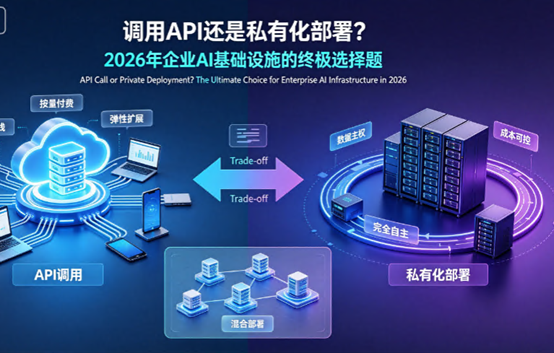
The most noteworthy trend in 2026 is the rise of hybrid deployment strategies. More and more companies are choosing the dual-track model of “privatization of core businesses and SaaS-based non-core businesses”.
For example, an insurance company deploys a claims review model involving customer privacy data in a private environment, and uses SaaS services for office scenarios such as internal knowledge Q&A and meeting minutes generation. This strategy takes into account security compliance and cost efficiency, and is becoming a best practice for enterprise AI deployment.
Specifically, a fast, low-cost privatized model can serve as a "frontline router" to handle 80% of high-frequency repetitive tasks; when complex edge cases are encountered, then seamlessly route to large proprietary APIs.
IDC predicts that by 2027, the proportion of enterprises adopting hybrid AI deployment strategies will exceed 60%.
Write at the end: Which one is suitable for your business?
Back to the original question: call API or private deployment?
API calls are a better starting point if your situation meets the following characteristics:
- It is in the product verification stage and needs to be launched quickly
- Traffic fluctuates greatly, making it difficult to estimate usage
- The data does not involve core business secrets or user privacy
- Lack of AI operation and maintenance team
Private deployment deserves serious consideration if your situation meets the following characteristics:
- The business has grown in scale, with daily calls exceeding millions of Tokens.
- Be in highly regulated industries such as finance, medical care, government affairs, etc.
- Data security is the lifeline of business
- Pursue long-term cost predictability
For most enterprises that have already passed the verification stage, hybrid deployment is the optimal solution.
In 2026, the choice of AI infrastructure is no longer either/or. Let what is suitable for privatization stay in the private environment, and let what is suitable for API use API - keep the choice in your own hands instead of leaving it to a single supplier.
Jtti is well aware of the infrastructure choices faced by enterprises in the AI era. We provide flexible and diverse cloud servers and private deployment solutions to help enterprises find the most suitable AI infrastructure path based on business stages and compliance needs. From high-performance GPU cloud servers to dedicated physical machine clusters, from elastic billing to long-term hosting - Jtti allows every ounce of your IT budget to be spent on what truly drives business growth.
If you are evaluating the deployment plan of AI infrastructure, welcome to contact Jtti, we will help you figure out the account clearly and take a stable path. The question is “how to use it”.