Many website owners think they're all set after buying a server and deploying their website. They think as long as the server is running, the website is accessible, and the backend is loginable, that's enough. However, the reality is that users complain about slow website access, suddenly receive DDoS attack alerts, and browsers display "insecure" messages—these are problems the server itself can't solve. It's like buying a car; no matter how good the engine, without seatbelts, headlights, or brakes, would you dare drive it?
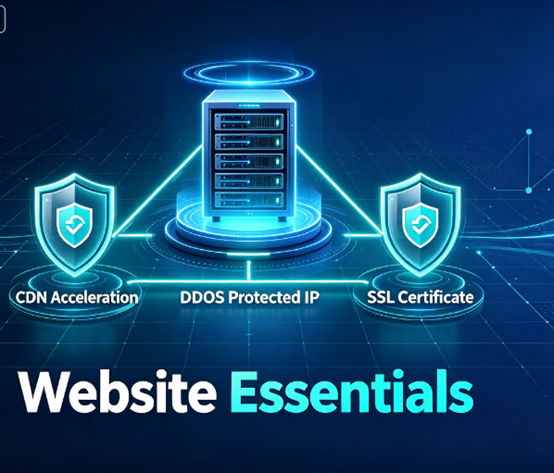
CDN, DDoS protected IPs, and SSL certificates are like the "seatbelts, headlights, and brakes" for a website. They aren't optional decorations, but essential equipment that determines whether a website can "safely travel."
CDN: Getting Your Website Running
The core logic of a CDN (Content Delivery Network) is simple: cache website content on the node closest to the user. When a user accesses the site, they retrieve the content directly from the nearest node, without having to fetch data from the origin server every time.
What problems does a CDN solve?
First, it significantly improves access speed. If your server is in Hong Kong, and a user is accessing it from Xinjiang—the physical distance is a factor; even the best network will experience latency. CDNs deliver content directly to users' doorsteps by deploying edge nodes globally. The CDN market continued its high growth momentum in 2026, with the total market size projected to reach RMB 259.8 billion, a year-on-year increase of 18.1%. Dynamic content has become mainstream, with its market share expected to reach 59.08% in 2026. The demand for low latency and high stability in real-time interactive scenarios such as live streaming, cloud gaming, and video conferencing continues to drive the development of the CDN industry.
Secondly, it significantly reduces the load on origin servers. Static resources such as images, CSS, and JS account for over 60% of website traffic. By caching these resources at edge nodes, CDNs allow origin servers to handle only dynamic requests—instantly reducing CPU and bandwidth pressure.
Thirdly, it provides global acceleration. The value of CDN is even more pronounced if your business covers multiple countries. The global cloud CDN market was valued at $9.05 billion in 2025 and is projected to grow to $10.63 billion in 2026. Enterprise customers contribute approximately 68% of revenue, with government and enterprise customers accounting for 22.3% of purchases, indicating that CDN is penetrating from the internet sector into traditional industries.
How to Choose a CDN?
In 2026, CDN pricing models shifted from single-rate traffic billing to a hybrid pricing model combining bandwidth, request count, and functional modules. Mainstream providers' pay-as-you-go daily cost is approximately 0.03-0.08 RMB/GB. When choosing a CDN, focus on: whether node coverage includes your target user region, whether it supports dynamic content acceleration, and whether it has basic DDoS protection capabilities.
High-Defense IP: Giving Your Website a "Bulletproof Vest"
DDoS attacks are one of the biggest threats to internet businesses. In 2025, the global peak DDoS attack speed exceeded 3.4Tbps. Your website might be a small e-commerce site, but a single attack of tens of gigabytes can completely paralyze your server—business interruption for several hours could result in the loss of an entire year's profits.
What is the core value of a high-defense IP?
Hiding the real origin IP. This is the core function of a high-defense IP. Attackers can only launch an effective attack if they find your real IP. High-defense IPs act as a "shield," with all traffic first passing through high-defense nodes for cleaning before being forwarded to the origin server.
Tbps-level cleaning capability. Mainstream high-defense solutions in 2026 already supported Tbps-level cleaning capabilities. High-defense IPs typically employ a "guaranteed protection + elastic protection" model—attacks within the guaranteed protection range are completely free, while beyond that range are billed on a pay-as-you-go basis, with scalability up to Tbps levels in seconds.
Line quality determines the actual user experience. High-defense IPs not only need to be effective but also fast. If the high-defense node takes a detour, although attacks are blocked, the latency is so high that it's unusable, essentially no different from no protection at all. Prioritize high-defense solutions with CN2 GIA lines; actual testing shows latency should be below 80ms (using Hong Kong nodes as an example).
How to choose a high-defense IP?
Consider five core indicators when choosing a high-defense IP: whether the protection bandwidth capacity matches the business scale, whether the cleaning technology is mature, whether the origin line quality is excellent, whether it supports elastic expansion, and whether the cost-effectiveness is reasonable. Small and medium-sized websites typically require 50-200Gbps of protection. In 2026, the starting price for mainstream high-defense solutions was approximately 5000-20000 RMB per month.
SSL Certificates: The Lock from "Insecure" to "Secure"
The red "Insecure" warning in the browser address bar is deterring more and more users. The purpose of an SSL certificate is to eliminate this warning—by using encryption technology to transform HTTP into HTTPS, protecting user data from eavesdropping or tampering during transmission.
What's the Difference Between Free and Paid Certificates?
Many people think, "Aren't free and paid certificates both encrypted? What's the difference?"—At the encryption technology level, there is indeed no fundamental difference between the two; both use the TLS 1.3 protocol and 256-bit AES encryption. The real dividing line lies in the depth of authentication.
Free SSL certificates (such as Let's Encrypt): Only verify domain ownership, issued in 5-10 minutes, valid for 90 days. Suitable for personal blogs, test environments, and non-core sites. Free certificates only provide basic encryption and do not verify the company's true identity—hackers can register similar domains (such as "taoba0.com") and obtain a "security lock" badge through free certificates to forge phishing websites.
Paid SSL certificates: Divided into three levels: DV (Domain Validated), OV (Organization Validated), and EV (Extended Validated). OV and EV certificates require verification of the company's true identity, and the company name will be displayed in the browser's address bar, increasing user trust. Annual fees typically range from 50-300 RMB (DV) to several thousand RMB.
How to choose an SSL certificate?
Personal blogs and showcase websites: Free DV certificates are sufficient. Corporate websites and e-commerce sites: It is recommended to choose at least an OV certificate to showcase the company's identity and enhance user trust. Highly sensitive businesses such as finance and banking: EV certificates are standard, as the company name is directly displayed in the address bar.
The synergy of the three: 1+1+1>3
CDN, DDoS protected IPs, and SSL certificates are not independent products; they can work together to form a complete closed loop of "acceleration + security + encryption."
CDN + DDoS protected IP is the golden combination for website security and performance. CDN improves access speed through node distribution, while DDoS protected IP defends against DDoS attacks. For high-traffic, high-risk internet businesses, this combination optimizes user experience while strengthening security. A further approach is the "DDoS protected IP + CDN" combination—cleaning traffic while maintaining acceleration.
DDoS protected IP + SSL certificate solves the compatibility issue of "encrypted transmission vs. traffic cleaning." Deploying HTTPS in a DDoS protected IP environment requires special attention to certificate configuration—DDoS protected IP may default to a specific TLS version, conflicting with existing certificate configurations. High-quality service providers deploy hardware-level SSL offloading modules to reduce CPU resource consumption from encryption processing.
SCDN (Secure CDN) is a fusion of the three—integrating DDoS protection, WAF, and SSL encryption on top of CDN acceleration. SCDN supports intelligent attack defense, identifying DDoS/CC attacks in real-time traffic analysis and automatically switching malicious traffic to DDoS protected IP for cleaning, while normal requests are still processed by accelerated nodes. Compared to purchasing CDN and DDoS protected IPs separately, SCDN offers advantages in terms of cost and operational complexity.
Jtti: A One-Stop Solution for Your Website's "Hidden Equipment"
If you're looking for a one-stop website acceleration and security solution, Jtti offers a complete product matrix, from CDN to DDoS protected IPs to SSL certificates.
DDoS Protected IPs: Jtti's DDoS protected IP service supports terabit-level DDoS mitigation capabilities and uses high-quality CN2 GIA lines to ensure fast origin server connections. Hardware-level SSL offloading modules are deployed within the DDoS protected IP environment to ensure high-concurrency processing capabilities for encrypted connections.
SSL Certificates and HTTPS Deployment: Jtti provides SSL certificate configuration services for websites, ensuring secure communication with CDN nodes via HTTPS protocol and protecting user data from theft.
For websites that require acceleration, security, and encryption simultaneously, instead of dealing with multiple service providers separately, it's better to choose a partner that provides a complete solution. Jtti is such a choice—from Hong Kong CN2 cloud servers to DDoS protected CDNs, from DDoS protected IPs to SSL certificate deployment, all in one place.