Why does your purchased VPS deliver lightning-fast speeds sometimes yet crawl at a snail’s pace other times? How vast is the performance gap between different providers? This article breaks down the real tier classification of the global VPS market for you.
What Creates the Gap Between VPS Plans Ranging From a Few Dollars to Thousands?
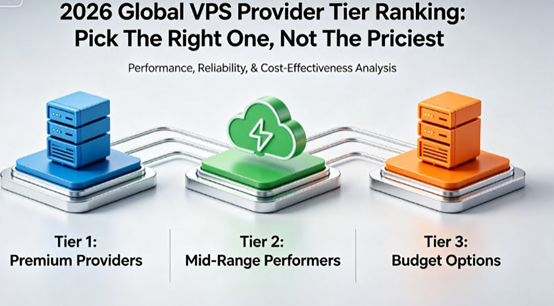
A quick search for "VPS" reveals an enormous price spectrum, from annual plans costing mere tens of yuan to monthly subscriptions worth thousands of US dollars. Many new users fixate solely on low pricing, only to receive laggy, packet-loss-prone servers—or even watch the provider vanish entirely—after purchase. The reasoning is straightforward: global VPS providers fall into distinct hierarchical tiers, each with different resource guarantees, network quality standards and business models.
Per industry reports, the global cloud computing market maintains annual compound growth exceeding 10%. Within this vast ecosystem, providers can be clearly split into three core tiers.
Tier 1: Global Cloud Giants
Traits Self-built data centers, proprietary global backbone networks, redundant power infrastructure, and enterprise-grade round-the-clock technical support. Formal SLA (Service Level Agreement) commitments guarantee uptime of 99.9% or higher.
Target Users Multinational corporations, listed enterprises, financial and healthcare firms with stringent data compliance rules, and internet platforms with millions of daily active users.
Core Advantages
1. Global Coverage: Dozens of availability zones across every continent to enable cross-region disaster recovery.
2. Elastic Scaling: Per-second or per-hour billing with automated resource scaling, ideal for businesses with volatile traffic loads.
3. Full-Fledged Ecosystem: Beyond VPS, providers offer a complete suite of cloud products including object storage, CDNs, managed databases and AI computing services.
Drawback Premium pricing. Even entry-level VPS instances often cost dozens to hundreds of US dollars monthly, with separate bandwidth charges. For personal blogs or small cross-border e-commerce stores, their feature set is overkill with poor cost efficiency.
One-sentence verdict The absolute peak of performance and reliability—but also the highest price bracket. Suited only for large-scale high-stakes businesses; individual developers should exercise extreme caution before committing.
Tier 2: Specialized VPS Hosting Providers
Traits Focus exclusively on virtual server rental without bloated enterprise cloud suites. Operate stable datacenters with proprietary AS numbers, intuitive management panels and extensive community documentation. Moderate price points with fully transparent hardware specs, boasting long-standing market reputations validated by years of user feedback.
Target Users Independent webmasters, solo developers, small cross-border e-commerce operators, tech enthusiasts and early-stage startups.
Core Advantages
1. Outstanding Cost Performance: Identical hardware configurations typically cost just one-third to one-half of Tier 1 equivalents.
2. User-Friendly Operations: Intuitive backend dashboards enable one-click OS reinstalls, snapshot backups and resource upgrades.
3. Flexible Billing: Hourly billing with instant instance termination, perfect for short-term testing workloads.
4. Robust Community Support: Extensive tutorials and third-party tools built around these platforms, making troubleshooting far simpler.
Key Caveats
1. Mild oversubscription on entry-level plans (oversubscription ratios ranging from 1:3 to 1:5), which may trigger minor performance dips during evening peak hours.
2. QoS bandwidth throttling enforced for high-traffic users; always review full bandwidth terms before checkout.
3. Heavily discounted promotional plans (e.g., Black Friday bundles) frequently suffer severe oversubscription; standard-priced entry packages are recommended instead.
Buying Tips
1. Prioritize providers offering hourly billing—test instances for a day or two at minimal cost.
2. Request official test IPs and run MTR diagnostics to manually audit routing paths and packet loss rates.
3. Search long-term user reviews on hosting technical forums, focusing on keywords such as "evening peak performance", "packet loss" and "support ticket response speed".
One-sentence verdict The sweet spot for casual operators and the top choice for personal websites and development environments.
Tier 3: Ultra-Low-Cost Entry Hosts
Traits Extremely cheap pricing (annual plans starting at less than 20 USD) paired with eye-catching advertised specs such as 2-core 4GB RAM and 5Mbps bandwidth. However, these services almost universally suffer extreme oversubscription, zero meaningful technical support, and a tangible risk of the operator shutting down permanently without notice.
Target Users Absolute beginners learning server basics, temporary disposable testing tasks, crawlers or bot scripts with zero stability requirements.
Core Flaw: Rampant Oversubscription
Oversubscription is the inherent flaw of cheap VPS services. A physical server officially rated for 16 cores and 64GB RAM could theoretically host a maximum of 16 × 1-core 4GB VPS instances. Budget operators routinely deploy 40 or even 60 virtual machines on the same hardware, gambling that tenants will not fully utilize resources simultaneously around the clock.
Validation Methods
After purchase, run the `top` command and monitor the `%st` (CPU steal) metric. Sustained values above 10% signal the host physical server is drastically overloaded. Execute `sysbench cpu run` during daytime and evening peak windows separately; if peak runtime triples or more, severe oversubscription is confirmed.
Other Common Pitfalls
1. Fake SSD Storage: Mechanical hard drives paired with temporary cache marketed as SSD; sustained `dd` disk read/write speeds consistently below 50MB/s.
2. One-Man Operation: Single-person management with no formal support staff or around-the-clock monitoring. If the operator loses interest or faces cash flow issues, all user data is lost instantly.
3. Misrepresented Network Lines: Advertised "CN2 premium lines" that route all traffic through standard 163 domestic carriers. Always verify routing via `traceroute`.
Acceptable Use Cases
- Learning Linux command-line operations and deploying LNMP development stacks
- Temporary testing of open-source software to be discarded afterward
- Scheduled lightweight scripts or low-frequency crawlers
Strictly Prohibited Use Cases
- Production websites, especially customer-facing e-commerce stores
- Storage of irreplaceable critical data
- 24/7 monitored business workloads
One-sentence verdict A stepping stone for learning purposes only; never intended for production-grade deployments.
Closing Thoughts
VPS provider tiers are not rigidly fixed, yet the core tradeoff remains constant: stability, raw performance and low cost cannot all be achieved at once. Tier 1 services deliver maximum reliability at a steep premium; Tier 2 balances performance and affordability, making them the optimal pick for most individual developers; Tier 3 services cut costs to the absolute minimum and serve solely as educational tools.
Before purchasing a VPS, ask yourself three critical questions:
1. Can my website or service tolerate over one hour of cumulative downtime per month?
2. Would irreversible data loss devastate my business if the provider disappears unexpectedly?
3. Am I willing to accept the above risks merely to save a small amount of money?
Once you answer these three questions clearly, you will know exactly which tier aligns with your needs.