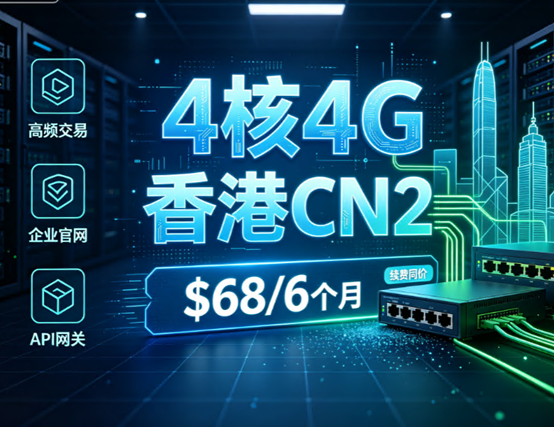
If you need a server that can withstand the millisecond-level latency of high-frequency trading and stably support your company's website and API gateway, then Jtti's package is hard to resist: 4 cores, 4GB RAM, 5Mbps dedicated bandwidth, CN2 optimized line, unlimited traffic—all for just $68 for 6 months.
How does this price compare to the Hong Kong CN2 market? Can this machine truly handle the three scenarios officially stated? Today, we'll break down the configuration, test the line, and explain the scenarios clearly.
Is $68/6 months worth it?
Here are the core specifications:
- CPU: 4 cores
- Memory: 4GB
- System Disk: 50GB SSD
- Bandwidth: 5Mbps dedicated bandwidth
- Line: Hong Kong CN2 optimized
- IP: 1 dedicated IP
- Traffic: Unlimited
- Price: $68/6 months (approximately $11.3/month)
- Promotional Restrictions: Limited to 1 unit per person, 15 units per day
What does this price mean in the Hong Kong CN2 market? Comparable Hong Kong CN2 servers typically cost $30-$50 or even more per month. $68 for six months equates to just over $11 per month—you'll find virtually no lower price among similarly configured and lined products.
Most importantly, the promotion page clearly states "same price for renewal"—meaning the renewal price will remain the same after six months, avoiding the "low price in the first year, double price in the second year" tactic. For users planning long-term use, this policy may be more valuable than the discount itself.
II. Line Analysis: What Makes Hong Kong CN2 So Superior?
This machine is labeled as having a "Hong Kong CN2 optimized line." CN2 is China Telecom's next-generation bearer network, and CN2 GIA is the highest-level product within it.
To put it simply, here are three key points:
First, true two-way optimization. Many cheap Hong Kong VPSs claim to have "CN2 lines," but in reality, only the outbound journey uses CN2 nodes, while the return journey uses the regular 163 backbone network—this is what's known as "pseudo-CN2." A true CN2 GIA requires both outbound and return journeys to pass through dedicated CN2 nodes starting with 59.43. According to industry reviews and user feedback, this machine uses a two-way CN2 optimized line, with latency as low as 10-30ms in South China and an average latency of approximately 40-60ms across all three major Chinese networks.
Second, no "collapse" during peak hours. Regular Hong Kong lines are most vulnerable during peak hours (8:00 PM - 11:00 PM)—packet loss rates spike, latency doubles, and websites become inaccessible. The CN2 GIA line, because it uses an independent backbone network channel, can stably control the packet loss rate below 0.5% during peak evening hours, with minimal latency fluctuations. This is crucial for scenarios with extremely high stability requirements, such as high-frequency trading and API gateways.
Third, direct connection to all three major networks. China Telecom uses the CN2 GIA backbone network, China Unicom uses AS4837 for direct connection, and China Mobile uses the CMI backbone network for direct connection—all three networks have direct connection paths for both outbound and inbound journeys, without going through third-party relays, eliminating the issues of "going around the US" or "going around Europe."
III. In-depth breakdown of applicable scenarios: Three scenarios, one machine handles them all
The official specifications indicate three applicable scenarios for this machine: high-frequency trading, corporate websites, and API gateways. These three scenarios have completely different server requirements, and the fact that one machine can cover them all demonstrates its well-balanced overall performance.
Scenario 1: High-Frequency Trading—Latency is Money
High-frequency trading demands "extreme" network performance. A 10-millisecond delay in a trading order can mean a price difference of tens of thousands of yuan. Hong Kong, as a financial center in the Asia-Pacific region and connected to major global exchanges, is an ideal location for deploying high-frequency trading servers.
What can this machine do?
- Ultra-low latency: The Hong Kong CN2 GIA line has a latency of 10-30ms to South China and around 40-60ms to East and North China. For high-frequency trading, this latency level is very close to a "local" experience.
- Extremely low packet loss: The CN2 GIA line consistently maintains a packet loss rate of less than 0.5%, ensuring that trading orders are not lost or retransmitted.
- Dedicated bandwidth: 5M dedicated bandwidth ensures that the transmission speed of trading orders will not be affected by neighboring resources during peak network periods.
- Unlimited traffic: Trading data volume may be small but the frequency is extremely high. Unlimited traffic means you don't have to worry about excessive charges due to sudden data surges.
Who is it suitable for: Individual quantitative traders, small hedge funds, cryptocurrency arbitrage bots, and forex EA trading.
Scenario 2: Corporate Website – Stability is Paramount
A corporate website may seem simple, but its requirements are actually quite comprehensive – it needs to load pages quickly (affecting user experience and conversion rates), be stable and reliable (avoiding frequent 502 errors), and withstand peak traffic (such as during promotional events).
This machine's 4-core, 4GB configuration is more than sufficient for running a corporate website. WordPress, corporate showcase sites, and small to medium-sized e-commerce sites (such as WooCommerce) can all run stably with this configuration. 5Mbps bandwidth is perfectly adequate for a corporate website with several thousand to tens of thousands of daily visits – combined with CDN and caching optimization, page load times can be near instantaneous.
The biggest advantage of the Hong Kong CN2 node is the lack of registration requirements and fast two-way access – fast access for both domestic and overseas customers. If your company has cross-border business, or your customers are located both domestically and overseas, the Hong Kong node is the only solution that can simultaneously address both ends.
Suitable for: SME websites, foreign trade company showcase sites, brand image sites, and SaaS product websites.
Scenario 3: API Gateway – The “Gatekeeper” in High Concurrency
The API gateway is the traffic entry point in a microservice architecture; all requests pass through it. Its server requirements are: high concurrency processing capability, low latency response, and high availability.
A 4-core CPU can handle multiple API requests simultaneously, and 4GB of memory is sufficient to support the gateway process and caching. The low latency of the Hong Kong CN2 line ensures that API callers (whether domestically or overseas) receive a fast response. 5M dedicated bandwidth is usually sufficient for API gateway scenarios—API request packets are typically small; latency and packet loss rate are key, not bandwidth size.
Suitable for: Cross-border SaaS platforms, mobile application backends, API entry points in microservice architectures, and third-party service integration gateways.
How to Choose Compared to Other Configurations? We'll Help You Make the Decision
This National Day promotion offers several configuration options:
HK CLOUD 4C4G ($68/6 months): Suitable for high-frequency trading, corporate websites, and API gateways. If you are running a business targeting domestic users, are latency-sensitive, and need a machine with balanced overall performance, this is the right choice.
JP CLOUD 2C2G ($28/6 months): Suitable for game acceleration, real-time audio and video, and localized services in Japan. If your users are mainly in East Asia (especially Japan) or you are doing game acceleration business, the Japan node is more suitable.
USA CLOUD 8C16G ($156/6 months): Suitable for big data analytics, video distribution, and cross-border SaaS platforms. If you are doing video business, data-intensive computing, or your users are mainly in North America, choose the high-end US model.
In short: For domestic markets and low latency, choose Hong Kong 4C4G; for Japan and gaming, choose Japan 2C2G; for North America and high performance, choose the US 8C16G.
Who is the best candidate for this Hong Kong 4C4G node?
If you meet any of the following criteria, this machine is worth serious consideration:
- You are doing quantitative trading, cryptocurrency arbitrage, or forex EAs and need a low-latency Hong Kong server.
- Your company website needs to be accessible to both domestic and overseas customers.
- You are operating a cross-border SaaS platform or mobile application and need a stable, low-latency API gateway.
- You are fed up with the "low price in the first year, double the price in the second year" scam and want a long-term machine with no price increase upon renewal.
- You have a limited budget (around $11 per month) but high requirements for performance and network connectivity.
Not suitable for:
- Your business requires extremely high bandwidth (video streaming, large-scale file distribution) → We recommend looking at high-end US models or dedicated servers.
- Your users are all located in North America or Europe → US nodes have lower latency.
- You need to run .NET applications on a Windows system → Check system compatibility.
Why is now a good time to buy?
First, the price is indeed low. $68/6 months is basically the lowest price in the Hong Kong CN2 4-core 4G configuration segment. Missing the promotion means the price will revert to the regular price (original price $339.78/6 months), a difference of nearly 5 times.
Second, same price for renewal. The promotion page clearly states "same price for renewal"—meaning if you buy it for $68, the renewal fee will still be $68 after six months. In today's industry where "low price in the first year, double price in the second year" is almost an industry norm, the value of this policy is self-evident.
Third, limited to 15 units per day. Only 15 units of each model can be purchased per day—not "sold out, still available," but truly limited. If you really need it, it's recommended to act quickly.
One machine, three scenarios, one price
High-frequency trading requires low latency—Hong Kong CN2 GIA is provided. A stable corporate website requires stability—4 cores, 4GB RAM + dedicated bandwidth is provided. High concurrency for API gateways requires high concurrency—4 core CPU + unlimited traffic is provided.
$68 for six months works out to $11 per month—this price for a Hong Kong CN2 4-core 4GB machine is indeed rare in the 2026 cloud server market.
Event Link: https://www.jtti.cc/activity/y2026-national-day.html
Limited to 15 units per day, 1 unit per person. If you have a genuine business need, we recommend placing your order as early as possible to avoid it selling out.